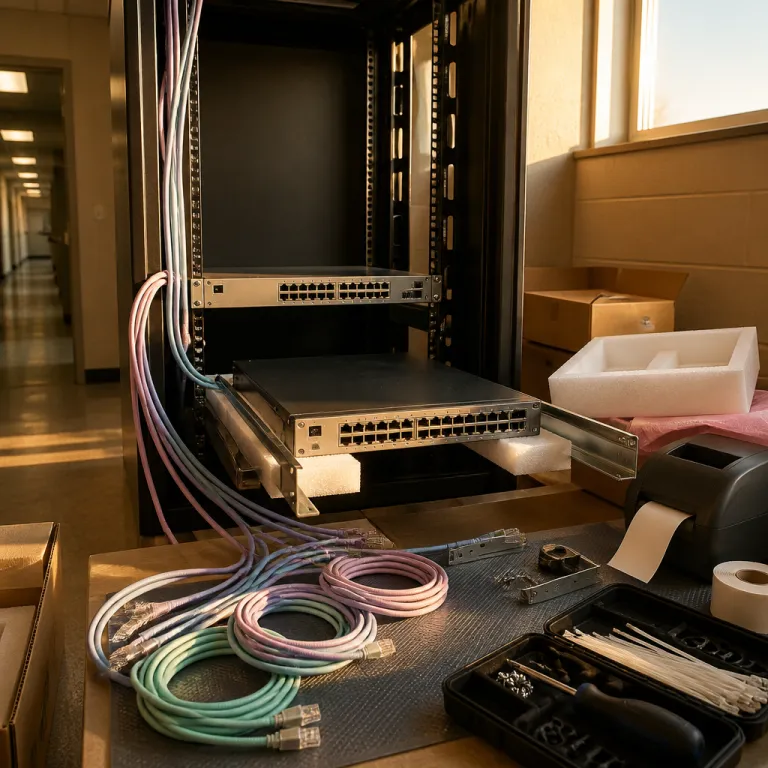
Why Alabama board approved contract network switches matter for work tech
Public sector work tech in the state of Alabama depends on predictable procurement. When an Alabama board approved contract network switch is in place, agencies gain a stable framework for buying networking hardware and related software without restarting every bid from zero. This structure reduces friction and lets IT leaders focus on service quality instead of endless paperwork.
For a city or county technology team, the difference is tangible. A pre-negotiated statewide network switch contract for products and services sets a clear rate, defines security expectations, and standardizes support for a multi-year period. That stability is especially valuable when internal networking upgrades must align with school calendars, board meetings, and fiscal deadlines.
These contracts also shape how vendors design their solutions. When a vendor wins an Alabama board approved contract network switch award, it often adapts its hardware and software products to meet state security baselines and county specific needs. Over time, this alignment creates a catalog of solutions that are easier to deploy, easier to audit, and easier to integrate with existing work tech platforms.
Governance, boards, and the mechanics of state level contracts
Behind every Alabama board approved contract network switch sits a governance process that blends policy, finance, and technology. A state level board typically defines the evaluation criteria, from networking performance and security features to total cost of ownership over the full year period. Agencies then rely on these contracts as a trusted backbone for their own work tech decisions.
The bid process is rarely simple, yet it is central to public trust. Vendors submit detailed proposals describing hardware architectures, software capabilities, managed services, and support service levels, all benchmarked against state and county requirements. Those bids are scored not only on price rate but also on security posture, interoperability, and the ability to serve both large city districts and smaller entities such as Escambia County schools.
Once the board approves a contract, the implications ripple across the state. A single Alabama board approved contract network switch award can become the default choice for multiple counties, school systems, and city departments that lack the capacity to run their own complex bid processes. For deeper analysis of how endpoint blind spots intersect with these governance decisions, see this expert discussion of endpoint management blind spots in modern work tech.
Key components of work tech in a contract driven networking environment
Work tech is more than devices on desks; it is the full stack of hardware, software, and services that enable secure collaboration. In an Alabama board approved contract network switch framework, the switch becomes the anchor that ties networking, security, and management tools into a coherent architecture. Every state or county deployment decision then builds on that anchor, from Wi-Fi access points to cloud access security brokers.
At the hardware layer, contract network switches must support high throughput, power efficient designs, and resilient architectures for both school campuses and administrative city buildings. They also need features such as VLAN segmentation, Quality of Service, and robust logging to support internal security monitoring and compliance reporting. On top of this hardware, agencies layer software defined networking tools, monitoring platforms, and automation solutions that translate raw connectivity into reliable work tech experiences.
Services complete the picture. Managed service providers deliver configuration, patching, and incident response, while local IT teams handle day to day service requests from teachers, social workers, and clerks. To keep these workflows efficient, many organizations now standardize printing, collaboration, and endpoint management around the same networking backbone, using practices such as effective printing workflows in modern work tech environments to reduce friction and cost.
From county realities to statewide strategy : Escambia County as a lens
County level deployments reveal how theory meets reality. Escambia County in Alabama, like many counties, must stretch limited budgets across schools, public safety, health services, and administrative offices, all while maintaining secure networking. When the county leverages an Alabama board approved contract network switch, it gains predictable pricing and standardized configurations that simplify this balancing act.
In practice, that means a school board in Escambia County can roll out new classroom technologies without renegotiating every hardware and software purchase. The same contract that covers core switches in a central data center can also govern access switches in remote school buildings and city annexes. Over a multi-year period, this consistency reduces configuration drift, lowers the rate of security incidents, and improves the reliability of digital services for residents.
Other counties across the state replicate this pattern, each adapting the same contracts to their own internal priorities. Some focus on security services such as network access control and intrusion detection, while others emphasize high availability for emergency communications. For a deeper look at how identifying friction points in these workflows transforms outcomes, examine this analysis of real business friction point identification in modern work tech journeys.
Security, networking, and the hidden risks in contract choices
Security is where an Alabama board approved contract network switch either proves its value or exposes its limits. When a board embeds strong security requirements into the contract, agencies inherit protections such as encrypted management, role based access control, and integration with centralized identity services. Weak requirements, by contrast, can lock the state into hardware and software that age badly over the agreed year period.
Networking teams must therefore treat contract language as a security control. Specifications for logging, firmware update cadence, vulnerability response, and third party security certifications directly influence how resilient the resulting work tech environment will be. A low bid that wins on price but underperforms on security services can create long term risk for every city, county, and school that relies on the contract.
Internal governance also matters. Agencies need clear processes for reviewing security advisories, coordinating with vendors, and escalating incidents that involve contract network switches and related products. When these processes are aligned across the state, counties such as Escambia County can benefit from shared expertise and faster responses, rather than facing complex threats alone.
Cost, value, and the economics of contract network switches
Public sector leaders often focus on the headline rate in a bid, yet the real economics of an Alabama board approved contract network switch extend far beyond unit price. Total cost of ownership includes maintenance, support services, training, and the operational impact of outages or security incidents. A slightly higher initial cost can yield better long term value if it reduces downtime and manual work for internal IT teams.
Contracts should therefore model costs across the full year period of the agreement. This means accounting for hardware refresh cycles, software licensing, optional security services, and potential expansion as new schools or city facilities come online. When boards compare bids using this broader lens, they can select solutions that align with both budget constraints and strategic work tech goals.
Value is also measured in flexibility. Contracts that allow agencies to scale up or down, add new products, or integrate emerging solutions without punitive fees support innovation across the state. Counties such as Escambia County, which may face fluctuating enrollment or shifting service demands, particularly benefit from this kind of adaptable contract structure.
Practical guidance for agencies evaluating Alabama board approved contract network switches
Agencies that rely on an Alabama board approved contract network switch still have important choices to make. Within the umbrella of an approved contract, they must select specific hardware models, software options, and services bundles that match their own networking topologies. A rural school district will not have the same needs as a dense urban city administration, even under the same statewide contract.
Start with a clear map of internal workflows and critical services. Identify which applications, from student information systems to case management platforms, depend most heavily on reliable networking and strong security controls. Then evaluate how each available contract product or service supports those priorities over the expected year period, rather than focusing only on immediate deployment costs.
Finally, use peer networks across the state to validate assumptions. Counties such as Escambia County can share real world performance data, incident histories, and lessons learned about specific contract network switch products and services. This collective intelligence helps boards refine future contracts and ensures that public sector work tech continues to evolve in a way that balances cost, security, and usability for everyone.
Key figures on public sector networking and work tech
- According to the National Association of State Chief Information Officers’ “State CIO Survey 2023,” networking and telecommunications typically account for around 20% of state IT infrastructure spending, highlighting how central contract network switches and related hardware are to public sector work tech strategies.
- Data from the U.S. Government Accountability Office’s 2020 report “Information Technology: Agencies Need to Develop Modernization Plans for Critical Legacy Systems” indicates that strategic use of governmentwide acquisition contracts can reduce procurement cycle times by up to 25%, a pattern that often translates to faster deployment of networking products and services in states such as Alabama.
- Studies by the Center for Internet Security, including the “CIS Community Defense Model v2.0” (2021), indicate that misconfigured network devices contribute to roughly 15% of reported configuration related security incidents in public entities, underscoring the importance of standardized configurations under board approved contracts.
- Research from the Consortium for School Networking’s “2022 K–12 IT Leadership Survey Report” notes that more than 90% of U.S. school districts now rely on high speed broadband, which in turn depends on robust contract network switches and managed services to maintain reliable and secure connectivity.
FAQ about Alabama board approved contract network switches and work tech
How does an Alabama board approved contract network switch simplify procurement ?
It provides a pre-negotiated framework that sets pricing, technical standards, and security requirements for networking hardware, software, and services. Agencies can then purchase within that framework without running their own full bid processes. This saves time, reduces legal risk, and promotes consistent configurations across the state.
Can counties like Escambia County customize solutions under a statewide contract ?
Yes, most statewide contracts allow counties and cities to choose from a catalog of approved products and services. Escambia County, for example, can select specific switch models, support levels, and optional security services that match its own school and administrative networking needs. The key constraint is that all choices must remain within the terms of the board approved contract.
What should agencies prioritize when comparing contract network switch options ?
Agencies should look beyond the initial rate and evaluate total cost of ownership, security capabilities, and alignment with internal workflows. Features such as robust logging, automation support, and integration with identity platforms often matter more over a multi-year period than small price differences. Peer feedback from other counties and school systems is also a valuable input.
How do these contracts affect security in public sector work tech ?
Security requirements embedded in the contract effectively become baseline controls for every participating agency. Strong language around patching, vulnerability management, and incident response helps ensure that contract network switches and related services support a resilient security posture. Weak or vague requirements can leave agencies exposed for the entire duration of the contract.
Are free or low cost networking products viable under board approved contracts ?
Free or very low cost products can play a role, particularly for testing or non critical environments, but they must still meet state and county security and support expectations. Board approved contracts typically emphasize reliability, vendor accountability, and long term support over headline price alone. Agencies should therefore treat free offerings cautiously and ensure they do not undermine overall work tech resilience.
Sources : National Association of State Chief Information Officers, “State CIO Survey 2023” ; U.S. Government Accountability Office, “Information Technology: Agencies Need to Develop Modernization Plans for Critical Legacy Systems,” GAO-21-524 (2021) ; Center for Internet Security, “CIS Community Defense Model v2.0” (2021) ; Consortium for School Networking, “2022 K–12 IT Leadership Survey Report.”
